

Businesses today are under more pressure than ever to move faster, serve better, and operate smarter. Artificial intelligence is no longer a future consideration. It is actively reshaping how organizations work, compete, and grow. For any business leader navigating today’s AI landscape, understanding enterprise AI transformation is not optional. It is foundational.
But here’s the uncomfortable truth most AI vendors won’t tell you: buying AI software is not the same thing as transforming your business. If your “AI strategy” is a chatbot that deflects tickets and a dashboard nobody checks, you haven’t transformed anything. You’ve just added another tool to the pile.
Real enterprise AI transformation changes how work gets done. And nowhere is that more visible, or more overdue, than the IT service desk.
What Is Enterprise AI Transformation?
Enterprise AI transformation is the process of embedding artificial intelligence into the core of how your business operates. Not bolting a chatbot onto your website. Not automating a single task. Fundamentally changing how decisions get made, how workflows move, and how your teams spend their time.
Think of it this way: digital transformation moved your files to the cloud and your processes online. AI transformation takes it further. It makes those systems think, learn, and act.
It is the difference between a customer service team that answers 200 tickets a day and an AI-assisted team that resolves 2,000, with higher accuracy and without burnout. Here is a more concrete example. A traditional IT service desk takes a password reset ticket, assigns it to a queue, waits for a technician to pick it up, and resolves it 45 minutes later. An AI-powered service desk verifies the user’s identity over SMS, resets the password, confirms it works, closes the ticket, and updates the documentation. All within minutes. No human involved.
That’s not deflection. That’s resolution. And the gap between the two is where enterprise AI transformation lives.
Why the IT Service Desk Is Ground Zero for AI Transformation
Every IT leader knows the math. The average cost of a Level 1 service desk ticket runs between $15 and $37, depending on which analyst report you pull. Multiply that by the thousands of password resets, access requests, and “how do I connect to VPN” tickets your team handles every month, and you’re looking at a massive operational cost center staffed by people who are overqualified for the work they’re doing.
The traditional approach hasn’t changed in 20 years: tickets come in, they sit in a queue, a human picks them up, follows an SOP, and closes them out. It’s slow, expensive, and the people doing it burn out fast because they’re not solving problems. They’re following scripts.
This is exactly where enterprise AI applications create the most immediate, measurable impact. Not by routing tickets to a different queue, but by resolving them end-to-end, from the actual documentation your team already maintains.
What a Transformed IT Service Desk Actually Looks Like
The capabilities that make this work are production ready. The right enterprise AI software delivers all of the following out of the box:
Knowledge Base Intelligence That Stays Current
The AI syncs directly with your Zendesk Help Center and ITGlue documentation on an hourly cycle. Every answer it gives comes from your actual SOPs, your actual policies, your actual knowledge articles. Not a generic model. When your team updates a doc, the AI reflects it within the hour. This is what separates enterprise AI software from consumer-grade chatbots.
Multi-Channel Support That Meets Users Where They Are
Employees don’t want to log into a portal to submit a ticket. They want to send a text, make a call, or message in Teams. A transformed service desk handles voice, SMS, chat, and traditional ticket submission natively, with full context carried across every channel.
Multi-Turn Ticket Conversations That Don’t Lose Context
This is not a one-shot Q&A bot. When a ticket requires follow-up, whether that’s additional information, a second verification step, or confirmation that the fix worked, the AI agent maintains the full conversation history and picks up exactly where it left off. Nothing falls through the cracks.
Intelligent On-Call Escalation That Respects Your Team’s Reality
When the AI can’t resolve something, it doesn’t just dump the ticket into a general queue. It knows your on-call rotation, your priority ordering, and your fallback teams. It detects voicemail and sends SMS alerts. It tracks callback attempts and escalates when maximum attempts are exhausted. It schedules SLA-aware callbacks by priority level, P1 through P4, so your most critical issues get human attention first.
Identity-Verified Password Resets Over the Phone
The number one L1 ticket at most organizations, handled entirely by AI, with SMS-based identity verification. No human needed. No security compromised.
Stuck Ticket Monitoring and Performance Tracking
Webhook alerts fire when tickets stall. Processing performance tracking shows ingestion-to-classification speed. Escalation analytics surface attempt counts, escalation reasons, and knowledge base gaps, so you’re not just running a service desk. You’re continuously improving it.
Coverage Visibility Your Team Can Actually Trust
A unified activity feed shows voice, chat, email, SMS, and ticket activity on a single timeline. A coverage health bar gives a visual indicator of on-call gaps before they become problems. Test call simulation lets you verify routing before you go live. This is the difference between enterprise AI tools that check a box and enterprise AI platforms that run an operation.
From L1 to L3: How AI Agents Scale Across the Service Desk
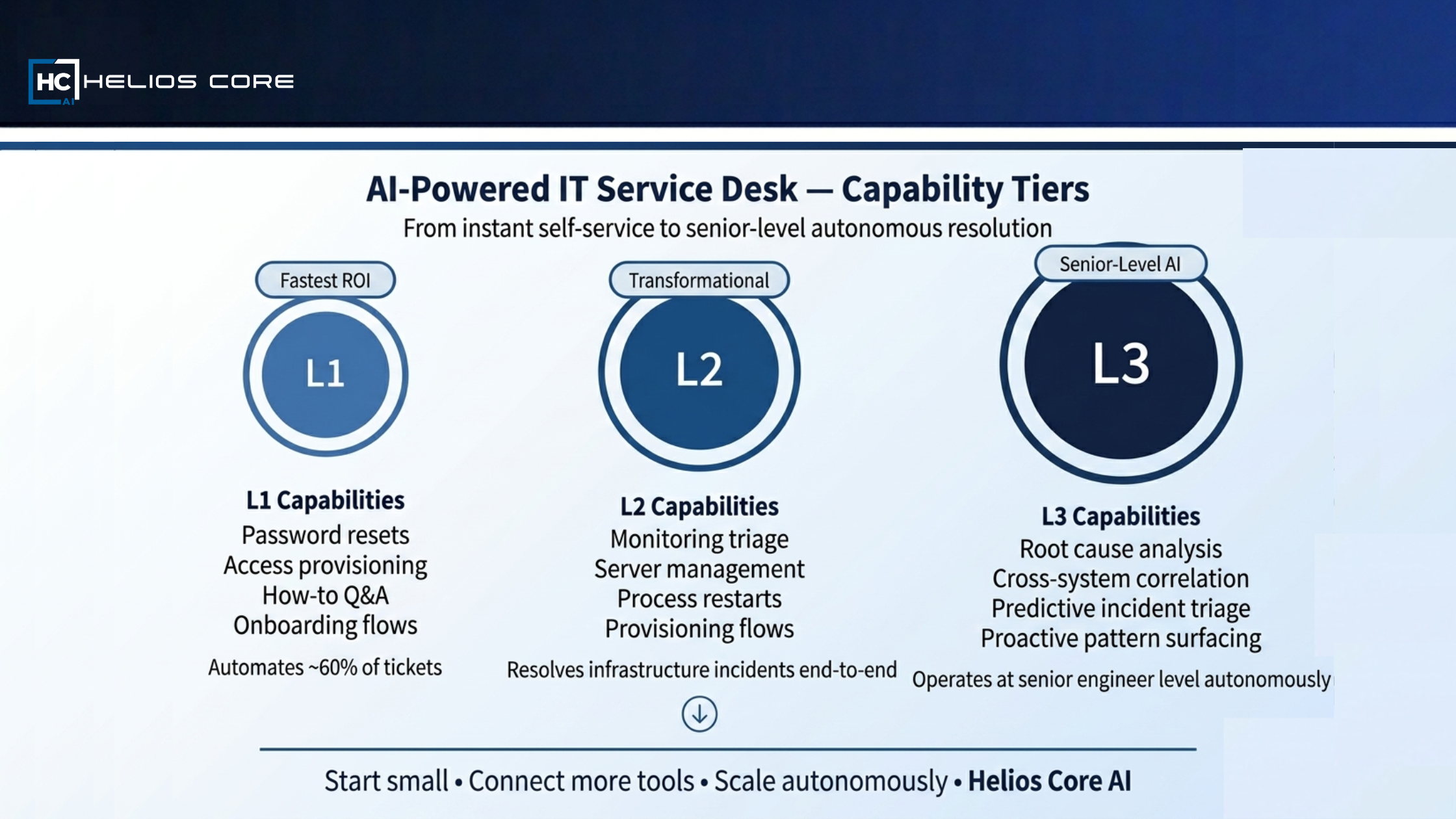
Most conversations about AI in IT support start and end with Level 1. Password resets. VPN questions. Account lockouts. That’s a great place to start, because L1 tickets are high volume, well-documented, and follow predictable patterns. But the right enterprise AI platforms are not static tools. They’re a ramp.
Level 1: The Starting Point
This is where most organizations begin, and where the ROI hits fastest. The AI agent resolves the tickets that consume the bulk of your service desk’s time: password resets with identity verification, access provisioning and deprovisioning, common how-to questions answered from your actual documentation, and standard onboarding and offboarding workflows. These are the tickets your best people shouldn’t be touching.
Level 2: Give It More Tools, It Does More Work
Once the L1 workload is running on autopilot, you start connecting the AI to deeper systems. Give it access to your monitoring stack and it stops waiting for a human to triage alerts; it reads the alert, correlates it against recent changes and known issues, and either resolves it directly or escalates with full context already attached. Give it access to your server and application management tools, and it starts restarting failed services, clearing stuck queues, and confirming systems came back healthy. This is where enterprise AI applications shift from “that’s convenient” to “that’s transformational.”
Level 3: Pattern Recognition and Root Cause Analysis
At this level, the AI doesn’t just react to individual tickets or alerts. It correlates data across systems to find the root cause behind recurring incidents. It sees that the same application has thrown the same error four times this week, traces it back to a memory leak introduced in last Tuesday’s deployment, and flags the engineering team with a detailed analysis before anyone has manually connected the dots. The point is not that AI replaces your senior engineers. It’s that your senior engineers stop spending their time on triage and start spending it on architecture, prevention, and the genuinely complex problems that require human judgment. The AI handles the detective work. Your people handle the decisions.
The Scaling Model
Think of it as a ramp, not a switch. You don’t go from zero to fully autonomous overnight, and you shouldn’t try to.
Start with L1 ticket automation. Get the high-volume, well-documented tickets off your team’s plate. Prove the model. Show the ROI.
Connect deeper tools incrementally. Each integration expands the AI’s capability. Monitoring tools, server management, provisioning systems, and change management platforms. Every new connection is a new category of work that the AI can handle. This is enterprise AI integration done right.
Build confidence through transparency. Every action the AI takes is logged, scored for confidence, and visible to your team. Low-confidence actions route to a human for review. High-confidence actions execute autonomously.
Shift your team up the value chain. As the AI absorbs L1 and L2 work, your people move into L3 engineering, architecture, security, and strategic projects.
The Building Blocks of Enterprise AI Transformation
The Right Enterprise AI Platforms
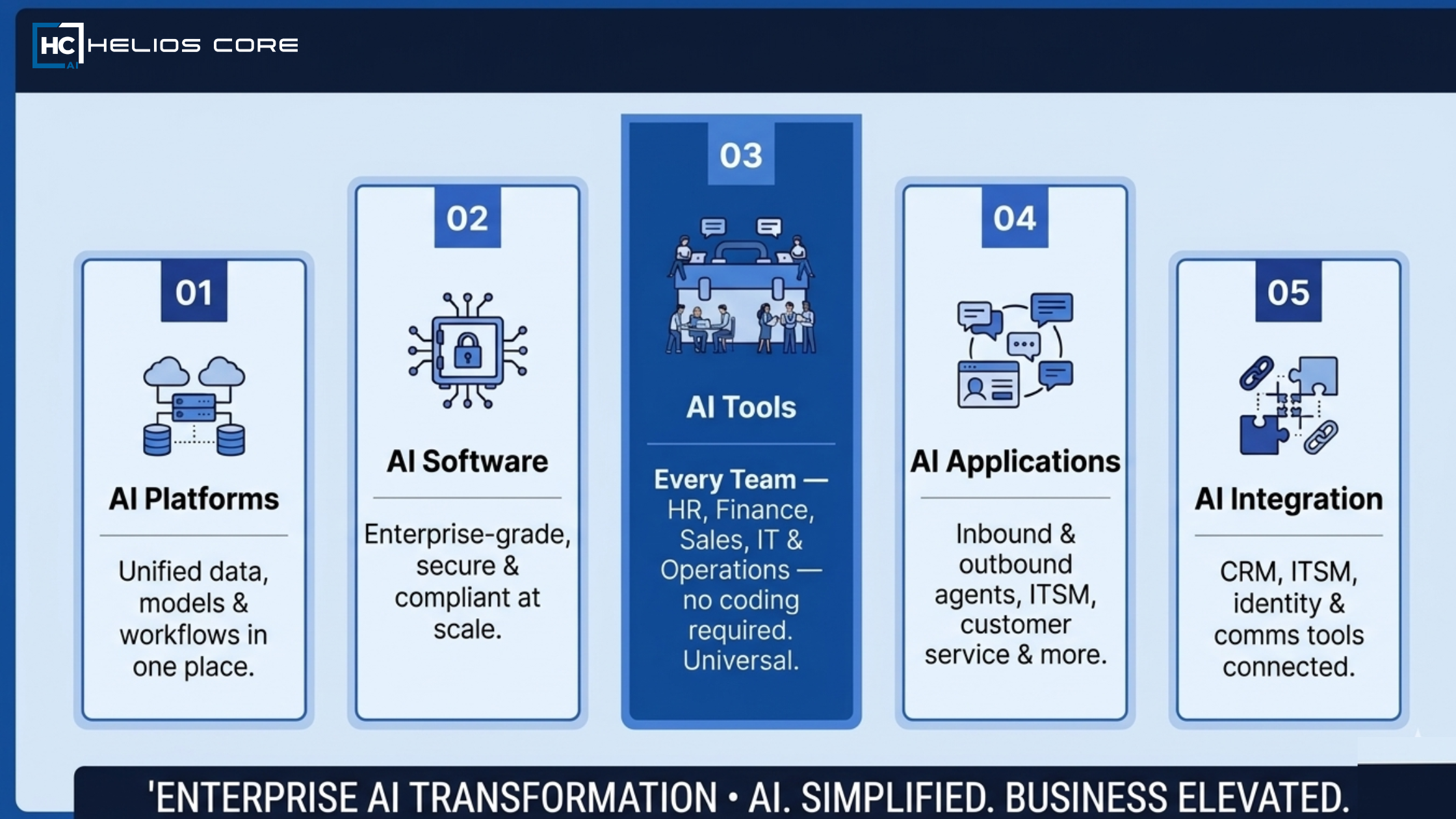
Everything starts with the foundation. Enterprise AI platforms are unified environments that bring your data, models, and workflows together. Rather than managing five disconnected point tools, one for ticket triage, one for chatbot responses, one for escalation, and one for analytics, the right platform gives your teams a single system of intelligence that operates across every function. Without the right platform, you’re not transforming. You’re experimenting.
Purpose-Built Enterprise AI Software
Not all AI is built for business-grade demands. Enterprise AI software handles the complexity of large organizations: multiple departments, thousands of users, sensitive data, and compliance requirements. It integrates with your existing ITSM tools like Zendesk and ServiceNow. It connects to your identity provider. It respects your business hours, your holiday schedules, and your escalation categories. This is where the leap from “AI pilot” to “AI at scale” happens.
Practical Enterprise AI Tools Across Every Team
One of the biggest mindsets shifts in AI transformation is realizing that AI is not just for the tech team. Today’s enterprise AI tools are accessible to HR managers automating onboarding, finance teams validating invoices, sales teams scoring leads, and customer service teams handling inbound calls. No coding required. When the right tools are in the hands of every department, transformation stops being a project and starts being a culture.
Diverse Enterprise AI Applications
The breadth of enterprise AI applications available today spans every corner of the business. AI agents that handle inbound customer calls around the clock. Outbound sales agents that pull CRM context and move leads through pipeline stages automatically. IT service desk agents that resolve tickets end-to-end from your actual documentation. The organizations winning right now are the ones applying AI to their most repetitive, high-volume pain points first, then expanding outward.
Seamless Enterprise AI Integration
The best AI in the world is useless if it can’t talk to your existing systems. Enterprise AI integration, connecting AI to your CRM, your ITSM platform, your ticketing system, your comms tools, your identity provider, and your documentation repositories, is what transforms a pilot into a business-wide capability. Real transformation requires AI that fits into how your people already work. Queue-to-team mapping that mirrors your existing Zendesk or Zoho structure. Webhook notifications that push to Slack, Teams, or PagerDuty. Contact directories that sync across every route. That’s integration done right.
AI Transformation Is About People, Not Just Technology
A common concern among business leaders is that AI will displace their workforce. The reality in IT is the opposite. Most L1 technicians didn’t sign up to reset passwords and follow scripts all day. They signed up to solve problems, learn new systems, and grow into engineering roles.
When an AI agent handles the repetitive, high-volume L1 workload, your technicians move into the work they want to do: infrastructure projects, security initiatives, and system design. You don’t lose headcount. You redeploy talent to higher-value work, reduce burnout, and improve retention. The organizations seeing the strongest results from enterprise AI transformation are the ones investing equally in their people and their technology.
Getting Started: What IT Leaders Should Do This Quarter
AI transformation doesn’t happen all at once. The organizations that try to boil the ocean end up with nothing to show for it. Here’s a practical path forward, one that works whether you’re starting your enterprise AI transformation journey or looking to scale what’s already working.
Start with your L1 ticket data. Pull your top 10 ticket categories by volume. Identify which ones follow a documented SOP. Those are your immediate automation candidates, and they’re probably consuming 60 to 70 percent of your service desk’s time.
Choose enterprise AI platforms that integrate with your existing stack. If you’re running Zendesk, ServiceNow, ITGlue, Azure AD, Teams, or Slack, your AI platform needs to connect to all of them, not ask you to rip and replace.
Don’t skip change management. Your tools are only as effective as the people using them. Bring your service desk team into the process early. Show them what AI handles and where they step in.
Measure outcomes from day one. Track resolution rates, mean time to resolution, escalation frequency, knowledge base gap detection, and employee satisfaction. Share wins with leadership to build momentum.
Think managed services, not set-and-forget. AI agents need continuous optimization: performance tuning, security hardening, data governance, and knowledge base updates. Treat your AI service desk like a living system.
About Helios Core AI
At Helios Core AI, we make enterprise AI transformation practical, scalable, and built around the real needs of your business.
Our Mira Platform puts three intelligent AI agents to work across your organization, backed by enterprise AI integration with 8,000+ apps and 99.9% uptime:
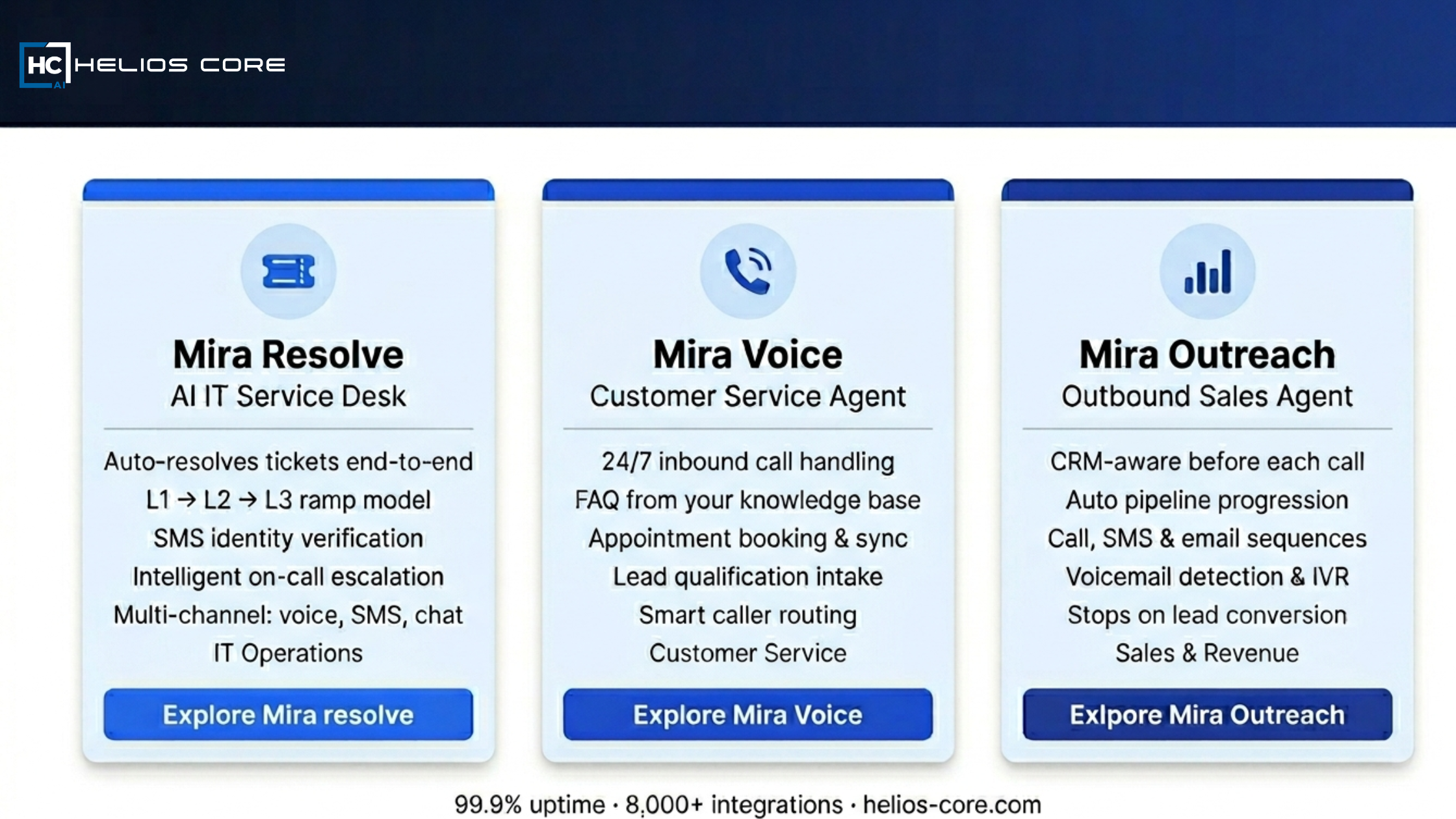
Mira Resolve is a full AI-powered IT service desk that resolves, not just deflects. Password resets with SMS identity verification. Access provisioning and deprovisioning. SOP-driven autonomous resolution from your actual Zendesk and ITGlue documentation. Monitoring alert triage with root cause correlation. Multi-channel support across voice, SMS, chat, and tickets. Intelligent on-call escalation with priority ordering, SLA-aware callback scheduling, and coverage health monitoring. Start at L1. Scale to L2 and L3 as you connect more tools.
Mira Voice is your always-on AI customer service agent. It handles inbound calls, answers FAQs from your real knowledge base, books appointments with calendar sync, qualifies leads with configurable intake questions, and routes callers with context so your human team never takes a blind transfer.
Mira Outreach is a CRM-aware AI outbound agent that reads lead context before every interaction, moves prospects through pipeline stages based on outcomes, handles voicemail detection and IVR navigation, and runs multi-channel sequences across call, SMS, and email.
Beyond the platform, our enterprise services team delivers AI strategy workshops, custom agent development, enterprise AI integration across ecosystems, and AI Managed Services (AIMS), so your transformation doesn’t stall after launch. We are a long-term partner, not a vendor.
The IT service desk of the future is not a future concept. It is running today.